
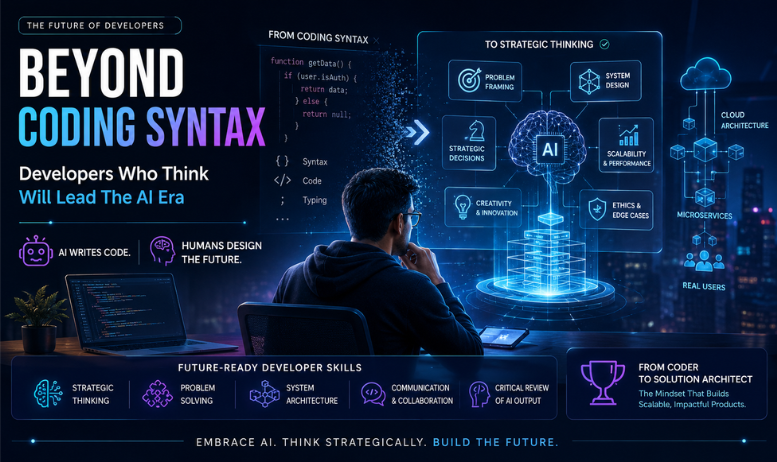
Beyond Coding Syntax: Why Developers Need Strategy, Creativity, and Problem-Solving in the AI Era
The future of software development in the AI era won’t reward people who memorize syntax. It’ll reward people who think. AI writes boilerplate now. What it can’t do is frame the problem, weigh trade-offs, or design a system that survives contact with real users. That’s the developer’s edge.
Roughly 41% of code on GitHub is now AI-assisted. Let that sink in. The future of software development in the AI era isn’t about typing faster, it’s about thinking sharper. At TechEnvision, we’ve spent 15+ years building software and digital products for 1000+ clients, and here’s the pattern we keep seeing: the developers who thrive aren’t the fastest typists. They’re the ones who ask, “Should we even build this?” before writing a line. AI handles the syntax. The strategy is on you.
What is the future of software development in the AI era? It’s a shift where AI tools generate, test, and refactor code, while human developers focus on architecture, problem framing, creativity, and judgment. Coding becomes a smaller slice of the job. Decision-making becomes the bigger one.
AI Impact on Software Developers: What’s Actually Changing
Look, the keyboard isn’t going away. But the value is moving. Copilot, Cursor, Claude, they autocomplete functions, scaffold tests, and explain legacy code in seconds.
So what’s left for you? Plenty.
- Problem definition. AI answers questions. It doesn’t decide which question matters.
- System design. Trade-offs between cost, speed, and scale are judgment calls, not autocomplete.
- Debugging the weird stuff. The bug AI can’t see because it doesn’t know your users.
- Ethics and edge cases. The 2% scenario that wrecks production.
Truth is, AI made the easy 80% of coding cheap. The hard 20% is now worth more than ever.
Software Development Skills for the Future
Here’s the uncomfortable bit: The skills that got you hired might not be the ones that keep you relevant.
Old Priority → Future-Ready Priority
- Memorizing syntax → Framing the problem
• Writing every line of code → Reviewing AI output critically
• Knowing one language deeply → Understanding systems broadly
• Speed of typing → Quality of decisions
• Following specifications → Questioning the specifications
Strategic thinking in software development is becoming the new baseline — not a nice-to-have skill, but the key factor that separates a coder from a builder.
Solution Architect Skills: The Role Everyone’s Climbing Toward
Want job security? Aim here. A solution architect doesn’t just build, they decide what gets built, how the pieces fit, and where it’ll break under load.
How to start growing into it:
- Read systems, not just functions. Trace how data moves end to end.
- Learn the cost of decisions. Every shortcut has interest. Pay attention to the bill.
- Practice saying no. The best architects kill bad features early.
- Communicate clearly. Half the job is explaining trade-offs to non-engineers.
- Use AI as a junior dev. Direct it. Review it. Don’t trust it blindly.
Real Scenarios We’ve Seen
A fresh graduate we mentored could write clean React but froze when asked why a feature mattered. Six months of strategy coaching later, he’s leading a small team. A startup we worked with shipped fast with AI but had zero architecture, so it collapsed at 10,000 users. We rebuilt the foundation. A junior dev automated her own boring tasks with AI and freed up hours for design thinking. She got promoted.
Different people. Same lesson. The thinking compounds. The typing doesn’t. Our team at TechEnvision builds software and trains talent around exactly this shift.
Challenges & Honest Solutions
“AI will replace me.” It won’t replace developers. It’ll replace developers who only do what AI now does. Move up the value chain.
“I don’t know where to start.” Pick one real problem. Solve it with strategy first, code second. Repeat.
“My fundamentals feel shaky.” Good. Knowing why code works beats knowing that it works. Double down on computer science basics, not framework trivia.
No overnight transformation here. Building real judgment takes months of deliberate reps. Anyone promising instant senior-level skills is selling something.
Conclusion
The developers who win the next decade won’t be the ones who code fastest. They’ll be the ones who think clearest. Strategy, creativity, problem-solving, these are the future-ready developer skills AI can’t fake. Start treating coding as one tool among many, not the whole job. At TechEnvision, we’ve watched this play out across 1000+ projects, and the verdict’s in. Curious where you stand? Talk to our team. We’ll tell you straight.
FAQs
Question1: Will AI replace software developers?
Answer: No. AI replaces repetitive coding tasks, not developers. The role is shifting toward strategy, architecture, and problem-solving, areas where human judgment, creativity, and context still beat any model. Developers who adapt become more valuable, not less
Question2: What skills do developers need to succeed in the AI era?
Answer: Strategic thinking, system design, problem framing, communication, and critical review of AI output. Strong computer science fundamentals matter more than memorizing syntax. Learn to direct AI tools rather than compete with them.
Question3: How is AI changing software development careers?
Answer: AI automates boilerplate code, testing, and documentation, pushing developers toward higher-value work like architecture and decision-making. Careers now reward people who understand why to build, not just how, accelerating the path toward solution architect roles.
Question4: Why should developers focus on strategy over coding syntax?
Answer: Because AI already writes syntax well. Strategy, knowing what to build, weighing trade-offs, and designing for scale, is where humans add irreplaceable value. It’s also the skill that leads to senior roles and long-term career security.