
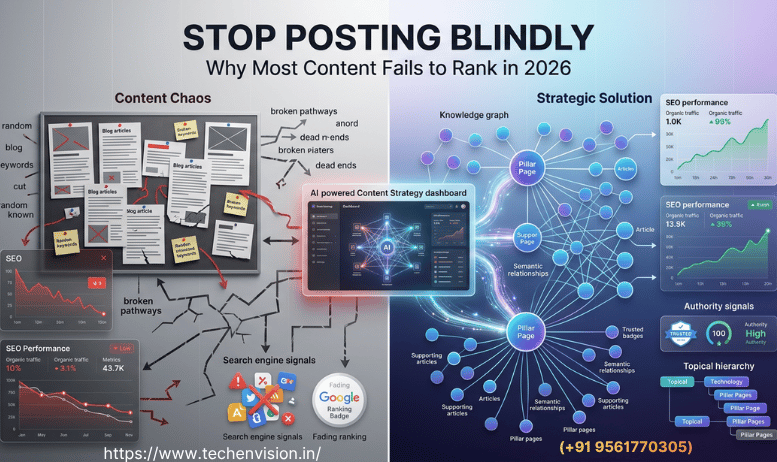
Stop Posting Blindly: The Hard Truth About Why Your Content Isn’t Ranking Without Topical Clarity
You’re probably working hard. You have a content calendar. You’re hitting your word count targets. Maybe you even have a freelancer churning out articles every week. But without true Topical Clarity, all that effort is just noise that Google ignores.
But your traffic? It’s flat. Or worse, it’s dropping.
At TechEnvision, we recently audited over 50 websites across e-commerce and industrial sectors. Here is the uncomfortable pattern we found in 94% of them:
They were shouting into the void.
Most websites don’t fail because of bad writing. They fail because Google literally cannot figure out what they are an expert in.
The “Volume Trap” We See Everywhere
We had a client recently a manufacturer of industrial equipment who came to us frustrated. They had published 80+ blog posts in six months. They covered everything from “history of casting” to “office safety tips” to “latest wax melter news.”
On paper, it looked impressive. In reality, it was a disaster.
Because every post targeted a completely different intent with no logical connection, Google viewed the site as a generalist magazine, not an authority on industrial casting. The result? None of their pages ranked for their core money keywords. Their “authority” was diluted across 80 weak pages instead of concentrated on 10 powerful ones.
This is the Volume Trap.
For years, the internet told us: Post more. The reality we’ve discovered at TechEnvision is different: Post connected.
The Shift: From “Keywords” to “Context”
If you want to rank in 2026, you have to stop thinking about individual keywords and start thinking about Topical Clarity.
Topical Clarity isn’t a buzzword; it’s the structural integrity of your website. It’s ensuring that every single piece of content you publish acts as a supporting beam for your main pillars.
Think of it like this:
- The Old Way: A bulletin board with random flyers tacked up wherever there’s space. It’s confusing, cluttered, and difficult for people to navigate or find the information they need
- The TechEnvision Way: A well-organized library. If a reader picks up a book on “Investment Casting Slurry Pots,” the system immediately guides them to related books on “Wax Melting” and “Foundry Safety.” They reinforce each other.
When you build this way, three things happen instantly:
- Google “Gets It” Faster: The search engine crawls your internal links and immediately understands your niche dominance.
- Users Stay Longer: Visitors aren’t hitting dead ends; they are guided through a journey of discovery.
- Rankings Compound: One page ranks, lifting the authority of the entire cluster.
Our Secret Sauce: The “Context-First” Audit
This isn’t just theory we read in a textbook. This is the exact framework we use when we onboard new clients at TechEnvision (www.techenvision.in). We don’t start by asking, “What do you want to write about?”
We start with our Context-First Audit:
Step 1: Identify the “Money Pillars”
We strip away the noise. What are the 3-5 core services that actually drive revenue? For an e-commerce client, it might be Platform Migration, UX Optimization, and Conversion Rate Design. Everything else is secondary.
Step 2: Build the “Knowledge Graph” (Not Just Clusters)
Most agencies stop at “clusters.” We go deeper. We map the semantic relationships. Under UX Optimization, we don’t just write generic tips. We create a tightly woven net:
- How mobile latency kills checkout rates (Data-driven)
- The psychology of trust badges in 2026 (Behavioral)
- Accessibility compliance as a ranking factor (Technical)
Every single one of these articles links back to the main pillar, and crucially, they link to each other in a logical flow. This creates a “mesh” of authority that is incredibly difficult for competitors to break.
Step 3: The Intent Alignment Check
Before a single word is written, we ask: What stage of the buyer’s journey is this for? Mixing a “How to buy” (transactional) article with a “What is” (educational) article on the same page confuses the algorithm. We separate them, then bridge them with strategic internal links.
The Result: Stability Over Chaos
When we applied this “Context-First” approach to the industrial client mentioned earlier, we didn’t write 80 new posts. We actually consolidated 40 of their weak posts into 10 powerhouse guides and rebuilt the internal linking structure.
The outcome? Within 90 days, their core keyword rankings stabilized. Their organic traffic didn’t just spike; it grew sustainably because the foundation was finally solid.
Don’t Let Your Content Go to Waste
If you are tired of publishing content that disappears into the void, it’s time to stop focusing on volume and start focusing on clarity.
At TechEnvision, we don’t just write blogs. We engineer content ecosystems designed to dominate search results. We combine strategy, consistency, and smart marketing to ensure every word you publish works harder for your business.
Ready to stop guessing and start growing?
Visit www.techenvision.in(https://www.techenvision.in/about-us/) today. Let’s audit your topical structure and build a roadmap that actually works.