
Beyond the Blue Links: A Strategic Guide to AI Content Optimization
I still recall when searching on Google felt like going on a treasure hunt. You would type a question, scan the descriptions, and click through the top results to find what you needed hidden in a long paragraph. That world is gone. If you have used a chatbot or an AI powered search engine even a handful of times recently, you know exactly what I mean. The answer appears instantly. No clicking required. The synthesis is right there. For AI Content Optimization strategists, this feels like the ground shifting beneath our feet. And honestly, it is.
If you are still writing your content the way you did in 2018, you are not just falling behind. Consequently, your content stops working for you. You are essentially writing for readers who have already migrated elsewhere. Before you start to worry, take a deep breath. The fundamentals of authority have not changed. Nevertheless, the mechanism of delivery has. The goal is not to trick a machine. Instead, you need to build content so useful and well structured that Generative AI has no choice but to cite you. Here is how to navigate this shift without losing your mind.
From Ranking to Referencing: The New Game
We need to get comfortable with a hard truth. Ranking is becoming less important than referencing. Large Language Models do not care about your domain authority score in the traditional sense. Furthermore, they do not care that you have been around for ten years. What they care about is utility.
When Artificial Intelligence generates a response, it scans a massive volume of information to find the most reliable answer for the user. Therefore, the AI operates like a researcher finishing a tight deadline. If the information in your content is unclear or buried behind marketing fluff, the Artificial Intelligence will not use it. Accordingly, the system moves on to the competitor who made extraction easier.
Your goal now is to become the source the AI trusts. You want to be the citation that powers the generated answer. This requires a shift in mindset. Specifically, you are no longer writing just for the human skimmer. When we design content for machine comprehension, we must simultaneously preserve the human reading experience. This might seem contradictory. However, it is completely logical. The content that machines prefer is usually the content that people prefer. Clear. Structured. Direct.
What Actually Earns Algorithmic Trust?
AI is not magic. It is math. And that math follows predictable patterns. When I review what gets cited and what gets ignored, I notice a consistent divide. There are four pillars that separate authoritative content from generic noise.
First, absolute clarity matters. I see countless brands attempting to sound sophisticated by using dense jargon. Conversely, that approach actively harms machine comprehension. Ambiguity is the enemy of algorithmic trust. If the AI has to guess your meaning, it likely will not cite you. State your thesis early. Use plain English. If your core point requires three paragraphs of buildup, you are already losing. Clarity reduces cognitive load for readers and computational load for models. It benefits everyone.
Second, strict structure drives extraction. Neural networks thrive on hierarchy. A wall of text is a nightmare for data parsing. This does not mean your content must look rigid. Rather, it requires logical headings, subheadings, and consistent formatting. Use bullet points for lists. Break up long paragraphs. Think of structure as scaffolding. Consequently, the AI can grab exactly the data point it needs without digging through prose.
Third, verifiable evidence builds authority. We are living in an era of infinite synthetic content. AI models are trained to prioritize empirical truth. If you make a claim, back it up. Cite primary sources. Include hard data. When an AI validates facts, content with clear trust signals ranks higher than vague assertions. Trust is no longer a feeling. It is a measurable metric based on citations and consistency.
Fourth, definitive purpose captures attention. Every piece of content should solve a specific problem. If your narrative wanders into brand storytelling before addressing the query, the AI may discard it. Keep your intent sharp. Answer the question first. Then, if necessary, add context. Never hide the solution.
Content Formats That LLMs Cite
Not all content performs equally in generative search. While you should maintain a diverse editorial calendar, certain formats are mathematically more likely to be referenced. Here is what works best right now.
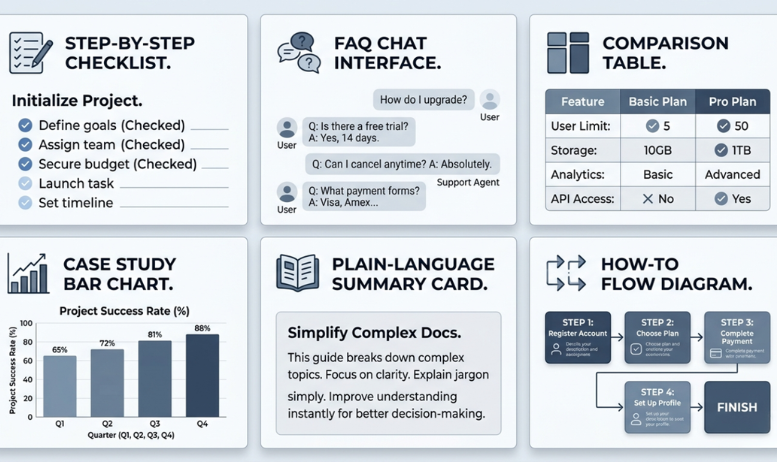
Sequential guides perform exceptionally well. AI loves sequential logic. How-to content that maps a clear trajectory from start to finish is highly citable. When a user asks how to complete a task, the system searches for a numbered sequence it can reproduce. If your guide is the clearest option available, the AI will likely pull your steps.
Structured question and answer pages deserve priority treatment. Stop treating FAQs as an afterthought. FAQs are essentially training data for generative models. You are providing the exact question users are asking along with the definitive answer you want surfaced. By anticipating long-tail queries and answering them directly, you are essentially pre-writing the AI response.
Comparison content influences purchasing decisions. Buyers often feel paralyzed by choice. Accordingly, they outsource decisions to AI. If you write comparison content, keep it structured. List pros, cons, use cases, and pricing tiers. This provides the balanced data the system needs to generate a recommendation. Control the comparison framework, and you influence the outcome.
Data-driven case studies build long-term authority. AI can synthesize generic advice, but it cannot fabricate real-world results. Case studies with hard numbers, specific outcomes, and verifiable details are invaluable. When an AI needs empirical proof, it will reference your work. This is how you demonstrate value that machines cannot hallucinate.
Plain language summaries bridge knowledge gaps. Complex industries require translation. AI models are frequently prompted to simplify dense topics. If you can distill industry-specific concepts into accurate, accessible language, you become the foundational reference for your sector. Ultimately, you establish yourself as the go-to authority.
Execution: Adapting Your Editorial Workflow
Strategy is useless if your team cannot implement it. I have watched organizations adopt AI-friendly guidelines and fail because their editorial processes remained unchanged. Here is how to operationalize this shift without turning your writers into robots.
Enforce visual hierarchy across all posts. Train editors to use H2 and H3 tags consistently. Stop publishing giant blocks of text. If a paragraph exceeds three or four sentences, look for a natural break point. Formatting should be a core competency, not a cleanup step.
Anchor every claim in reality. Create an editorial rule. No statement without a source. If a writer references an industry standard, link to the standard. If they quote a statistic, link the original report. Give the AI the trust signals it requires to validate your content over competitors.
Anticipate the user journey. Do not simply answer the primary keyword. Think three steps ahead. If you are writing about CRM software for small businesses, the reader will inevitably wonder about pricing, integrations, and implementation time. Address those friction points within the article. You are mapping the complete journey, not just matching a query.
Eliminate generic filler. AI can produce mediocre summaries in milliseconds. If your content reads like a standardized encyclopedia entry, you are competing against the very system you are trying to influence. Add your unique perspective. Share contrarian views. Include hard-earned insights that only experience can provide. That human edge preserves your value even when AI synthesizes the answer.
The Long Game
The shift to AI-driven search is not a temporary disruption. It is the permanent baseline for how people acquire knowledge. Mastering AI Content Optimization is not about gaming the system. Rather, it is about elevating your organizational knowledge to a standard of absolute utility. You must be so clear, so structured, and so trustworthy that generative models have no alternative but to point to you.
The gatekeepers have changed. The traditional blue links are taking a back seat. Nevertheless, the demand for authority has not disappeared. It has simply become harder to earn. Audit your top-performing content today. Is it clear? Is it structured? Is it verifiable? If the answer is no, it is time to rewrite. The future belongs to brands that communicate with precision, maintain logical structure, and deliver undeniable value. To summarize, adapt your framework, enforce editorial discipline, and position your expertise where machines and humans can both find it.