
AI Learning: Is It Making Us Smarter, or Just Faster? The Right Way to Use AI in Education
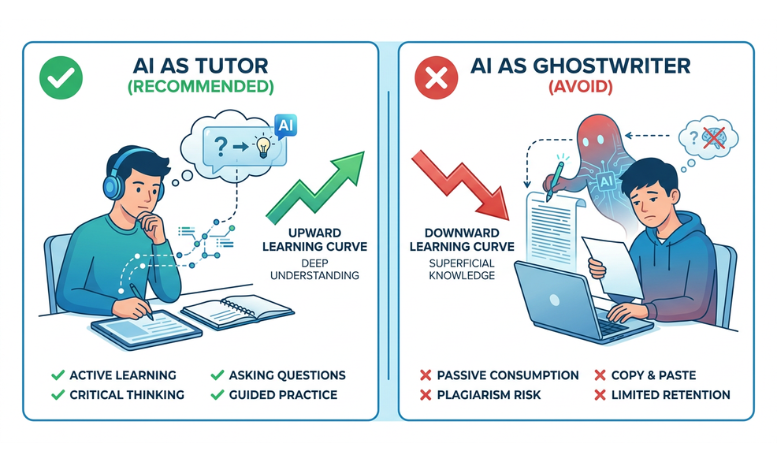
AI Learning means using tools like ChatGPT to study, practice, and understand faster. It works when AI acts as a tutor, not a ghostwriter. A 30-month study of 26,000 students found AI raised homework scores but weakened long-term retention when students leaned on it too hard.
Here’s a number that should stop you cold: 26,000 students, tracked over 30 months, and the ones who leaned hardest on AI learned the least over time. AI Learning boosted their homework scores. It cut their study hours. But the retention? It cratered. We’re TechEnvision, and after 15+ years and 1000+ clients, we’ve watched this exact pattern play out with tools before: the shortcut that feels like a win until the test comes. This piece unpacks how to use AI so it sharpens your brain instead of renting it.
What Is AI Learning?
AI Learning is the practice of using artificial intelligence tools, chatbots, tutors, study assistants, to explain concepts, quiz you, and speed up understanding. Done right, it supports thinking. Done wrong, it replaces it. That distinction decides everything.
The Study Nobody Wants to Talk About
The headline result sounds great. Higher scores. Less time. Who says no to that?
But the follow-up data told a darker story. Students who used AI to produce answers, essays, solutions, worked-out problems, scored well short-term and forgot fast. The ones who used AI to check their own thinking held onto the material. Same tool. Opposite outcome.
Think of it like a calculator. Hand it to someone who already gets multiplication, and they fly. Hand it to a kid who never learned it, and they’re helpless the second the battery dies. AI is that calculator for thinking.
Tutor vs. Ghostwriter: The One Rule That Matters
Every AI study session falls into one of two buckets. Know which one you’re in.
Here’s the table rewritten as plain text:
-
AI as Tutor
- You ask: “Explain why this is wrong.”
- Your effort first: Yes, you attempt it.
- Long-term learning: Goes up.
- Test-day result: You remember.
-
AI as Ghostwriter
- You ask: “Write this for me.”
- Your effort first: None.
- Long-term learning: Drops sharply.
- Test-day result: You blank.
The rule is simple. Struggle first. Then verify. Never the other way around.
How to Use AI for Learning Effectively (5 Steps)
Want the best way to use AI as a study assistant? Follow this order every time.
- Attempt it solo. Write your answer, solve the problem, draft the essay. No AI yet.
- Ask AI to critique, not replace. “Where’s my logic weak?” beats “Give me the answer.”
- Make it quiz you. Have AI generate practice questions and grade your reasoning.
- Demand the “why.” Don’t accept an answer. Ask it to explain the steps.
- Close the tab and redo it. If you can’t reproduce it without AI, you didn’t learn it.
That last step is the whole game. Retention lives there.
Where This Shows Up in the Real World
We’ve seen the same dynamic outside classrooms, in the skill-building work our clients do daily.
- A college grad used our recommended workflow to prep for coding interviews, AI explained failures, didn’t write the code. Offer landed in six weeks.
- A working professional upskilling in digital marketing used AI to quiz herself on ROAS, CPC, and keyword research instead of copy-pasting notes. She actually retained it.
- An educator built AI-driven practice sets for students, then banned AI on the graded portion. Scores held.
If you’re serious about structured, responsible AI usage for skill development, our AI Learning course walks you through the tutor-first method step by step. And if you’re mapping a broader learning path, our guide to building digital skills that actually stick pairs well with it.
Challenges & Honest Solutions
Problem: AI dependence kills recall. The fix isn’t banning AI. It’s sequencing it, effort first, verification second. We coach exactly this.
Problem: Students can’t tell good answers from confident nonsense. AI hallucinates. Independent thinking before the prompt is your fact-checker. Build the instinct, then use the tool.
Problem: No structure, just random prompting. Aimless AI use is like driving with no destination, lots of motion, no progress. A guided path fixes it.
The Bottom Line
AI won’t make you smarter. How you use it will. Treat it as a tutor and your understanding compounds; treat it as a ghostwriter and you’re renting knowledge you’ll never own. That’s the hard truth 26,000 students proved. At TechEnvision, we build learning systems around that principle, real skill, real retention, no shortcuts that collapse on test day. Ready to use AI the right way? Start with a plan, not a prompt.
FAQs
Question: Does AI improve learning outcomes?
Answer: Sometimes. AI improves short-term scores and cuts study time, but long-term learning drops when students over-rely on it. According to a 30-month study of 26,000 students, verification-based use helped retention while answer-generation hurt it.
Question: What’s the best way to use AI as a study assistant?
Answer: Attempt the work yourself first, then use AI to critique your reasoning, quiz you, and explain mistakes. Never ask it to produce the final answer before you’ve tried. Effort first, verification second.
Question: Is using AI for homework cheating?
Answer: It depends on how. Using AI to understand a concept or check your logic is studying. Using it to write your assignment word-for-word is outsourcing, and it wrecks long-term learning.
Question: Can AI replace teachers?
Answer: No. AI handles explanation and practice well, but it can’t model curiosity, judgment, or accountability. The best results come from AI plus human guidance, not AI alone.