
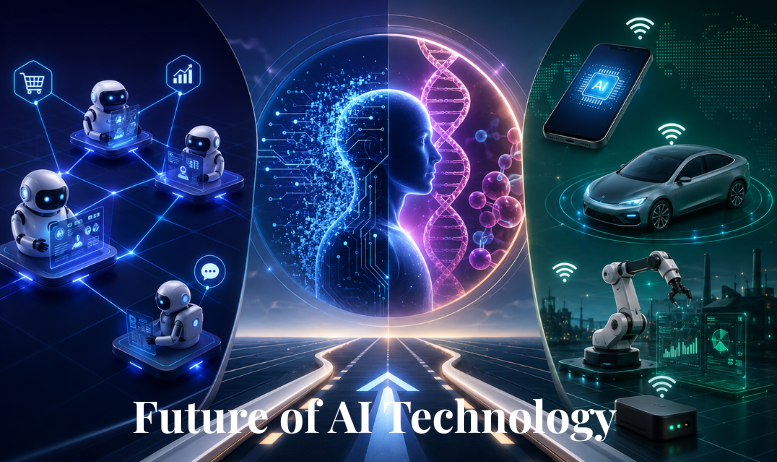
After AI, What Comes Next? The Future of AI Technology, Explained
What comes after AI isn’t a replacement. It’s a stack. Autonomous agent ecosystems, AI infrastructure, and ambient digital intelligence are the next phase, and the businesses preparing now will own 2027. Here’s the honest forecast, minus the hype.
Eighteen months ago, “AI” meant a chatbot you typed into. Now it books your meetings and writes your code. So what comes after AI? Short answer: AI that runs itself. At TechEnvision, we’ve spent 15+ years and 1000+ client projects watching technology cycles arrive, peak, and get oversold. This one’s different. The problem most teams have isn’t understanding AI. It’s preparing for what the future of AI technology actually demands next, without drowning in noise.
What is the “next phase” of AI? It’s the shift from tools you prompt to systems that act, autonomous agent ecosystems built on heavy AI infrastructure (compute, data pipelines, orchestration layers) that coordinate tasks with minimal human input.
The three waves, and where we are now
Wave one was generative. You asked, it answered. Wave two is agentic. Software that plans, decides, and executes. Wave three? Ambient. Intelligence baked into everything, quietly running in the background.
We’re mid-wave-two. Most companies are still stuck in wave one.
That gap is your opportunity.
Autonomous agent ecosystems
Think of a single AI tool as one smart employee. An agent ecosystem is the whole department, agents handing work to each other, no manager pinging Slack at midnight.
- One agent researches.
- One drafts.
- One reviews and ships.
According to McKinsey’s 2025 research on generative AI, the biggest value comes not from single tools but from workflow-level automation. That’s the agent ecosystem in a sentence.
The AI infrastructure phase
Here’s the thing nobody puts on the slide. Agents are hungry. They need data plumbing, clean APIs, and compute that doesn’t fall over. This is the AI infrastructure phase, the unglamorous wiring underneath the magic. Skip it, and your fancy agent stalls like a sports car on an empty tank.
How to prepare for emerging technologies by 2027
You don’t need a moonshot. You need a sequence.
- Audit your data. Messy data kills agents. Clean it first.
- Pick one workflow. Automate it end to end before scaling.
- Build the plumbing. APIs, integrations, monitoring.
- Train your people. Tools change. Judgment compounds.
- Measure ruthlessly. Track time saved and ROI, or you’re guessing.
Real scenarios we’ve seen
A startup founder asked us to “add AI.” We found their CRM and site weren’t even talking to each other. We fixed the foundation first, then layered automation, and their lead response time dropped from hours to minutes. An e-commerce client wanted agents; what they needed was a faster, properly maintained site so the automation had something solid to sit on. Our digital and IT services team handles both halves: the strategy and the wiring.
Challenges and solutions
Hype over readiness. Everyone wants agents; few have the data to feed them. We start with an audit, not a sales pitch.
Tool sprawl. Ten subscriptions, zero integration. We consolidate and connect, so your stack works as one.
No clear ROI. “AI” on a budget line isn’t a result. We tie every build to traffic, leads, or sales, the only metrics that pay rent.
The bottom line
What comes after AI is AI that works while you sleep, coordinated, infrastructure-backed, quietly everywhere. The winners in 2027 won’t be the ones who adopted earliest. They’ll be the ones who built the foundation right. That’s the work we’ve done for 1000+ clients across 15 years, and the work we’d do for you. Want to know if your business is actually ready? Start with an honest audit. TechEnvision can run one.
FAQs
QUESTION: What’s the next big technology after AI?
ANSWER: Not a single technology, a phase. Autonomous agent ecosystems running on robust AI infrastructure, evolving toward ambient intelligence embedded in daily tools and workflows by 2027.
QUESTION: What are autonomous agent ecosystems?
ANSWER: Networks of AI agents that pass tasks to each other and execute workflows with minimal human input, like a self-coordinating team handling research, creation, and review automatically.
QUESTION: How do I prepare my business for 2027 tech trends?
ANSWER: Clean your data, automate one workflow fully, build proper API infrastructure, train your team, and measure ROI. Foundation first, automation second. Skipping steps wastes budget.
QUESTION: Is AI going to be replaced?
ANSWER: No. It’s being extended. The future of AI technology layers agents and infrastructure on top of today’s models, rather than swapping them out.