
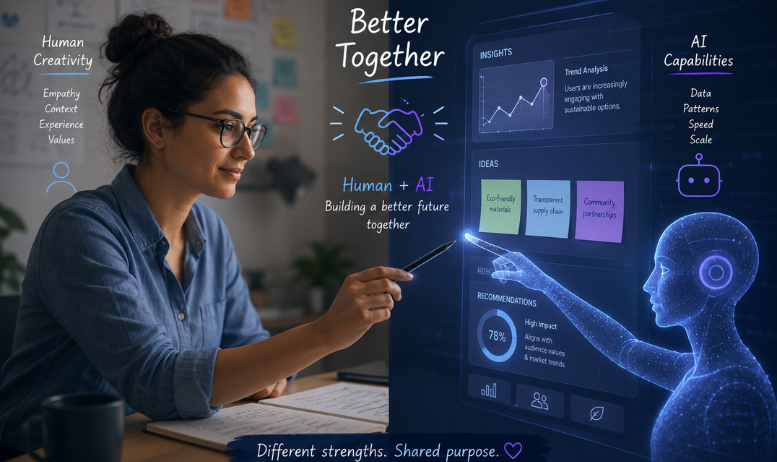
Beyond the Hype: The Human Skills AI Can’t Replace
Let’s be real: every time you open LinkedIn or a tech news site lately, it feels like the same headline is screaming at you: “AI is going to take your job.”
But that’s only part of the story. The more important conversation is about the Skills AI Cannot Replace the uniquely human abilities that help people adapt, lead, create, and thrive no matter how advanced technology becomes.
If we’re being truthful, that kind of messaging does something to us. Even if you don’t fully believe it, the doubt still lingers in the back of your mind: What happens to my role? My skills? My future?
However, here is where most of this conversation goes wrong. It isn’t really about AI replacing you; it’s about how you choose to work with it. And that single shift changes everything.
The Real Shift Isn’t Job Loss It’s Job Transformation
Look, some tasks are disappearing. That is a fact.
- Chatbots are handling basic customer support.
- AI tools are managing first-level bookkeeping.
- Automated systems are taking over repetitive admin work.
Consequently, if your job consists solely of repeating predictable tasks, things will get uncomfortable. But, here is what people often forget: technology rarely kills entire careers. Instead, it kills specific parts of jobs and reshapes the rest.
We have seen this pattern before. When calculators arrived, accountants didn’t vanish. When spreadsheets changed the game, analysts didn’t disappear. They simply stopped doing low-value work and moved up the chain. Similarly, AI is doing the same thing just much faster.
Therefore, the real question isn’t “Will my job exist?” It is “What will my job evolve into?”
Why Critical Thinking Has Become a Survival Skill
Now, here is where it gets interesting. We are entering a world where AI can generate strategies, reports, code, and marketing plans in seconds. On paper, that sounds impressive. Yet, there is a crucial detail we must consider: AI doesn’t understand context. You do.
Let’s say an AI suggests a cost-cutting move that saves 15% instantly. On paper, it looks perfect. But, what if it damages long-term client trust? What if it weakens your brand positioning? An algorithm doesn’t care; it just optimizes numbers. You, however, are the one who has to live with the consequences.
That is why critical thinking is becoming more valuable than raw execution. People don’t just need answers anymore; they need someone who can ask the hard questions:
- “Does this actually make sense in this specific situation?”
- “What are we missing?”
- “What happens six months from now, not just today?”
Fortunately, that ability doesn’t come from AI. It comes from you slowing down and thinking deeper than the output provides.
Emotional Intelligence Is No Longer a “Soft” Skill
Let’s clear something up immediately: we still call emotional intelligence a “soft skill.” That label is outdated. In real-world workplaces, EQ is often what decides everything.
Consider these realities:
- A leader doesn’t just assign tasks; they build trust.
- A manager doesn’t just track performance; they handle people.
- A salesperson doesn’t just sell; they read emotions.
While AI can process data, it cannot build human trust. It cannot sense hesitation in a room. It cannot comfort a stressed patient or inspire a team to push through uncertainty. That remains your domain. In fact, in many cases, that is the part people will pay more for in the future, not less.
Creativity Is Changing, Not Disappearing
There is a common fear that AI will “replace creativity.” Actually, what is happening is different. AI is becoming a tool for execution, while humans still own the ideas that matter.
AI can:
- Generate 100 design variations.
- Write 20 versions of a headline.
- Remix existing styles.
However, it does not know:
- What your customer is truly frustrated about.
- What emotion your brand should stand for.
- What problem is worth solving in the first place.
That insight comes from lived experience from watching users struggle, sitting in meetings where things fall apart, and noticing patterns others ignore. That is where real creative advantage lives.
You Still Need Digital Skills Just Not in the Old Way
Let’s be clear: human skills alone are not enough. If you ignore technology, you will fall behind just as fast. Nevertheless, the definition of “technical skill” has changed. It is no longer about memorizing tools; it is about understanding how to work with systems.
You don’t need to be the best coder in the room. But, you do need to understand:
- How AI tools fit into your workflow.
- How to interpret outputs without blindly trusting them.
- How to automate the repetitive parts of your job.
Think of AI like a co-pilot. If you don’t know how to fly at all, you are stuck. But, if you know the basics, AI takes you further than ever before. The winning formula is now a combination of human judgment and machine speed.
What You Can Actually Do Starting Today
Let’s bring this down to earth. You don’t need a massive career reset; you need small, strategic shifts.
- Audit Your Daily Work Honestly: What are you repeating every day that a machine could handle? Free that time up and use it for thinking, not just doing.
- Practice Explaining Things Simply: If you can take a complex AI output and explain it in plain language, you become extremely valuable. Most people cannot do this.
- Invest in Relationships, Not Just Skills: Opportunities rarely come from dashboards. They come from trust mentors, peers, and collaborators. Make sure you nurture these networks.
- Stay Curious About How Things Actually Work: Go beyond how to use tools. Understand why they work, where they fail, and what they cannot do. This is where real confidence comes from.
Final Thought
AI isn’t the end of human relevance; it is the beginning of a different kind of work. Those who struggle will be the ones trying to compete with machines on speed. Those who win will be the ones who lean into what machines cannot do: judgment, empathy, creativity, context, and trust.
So, don’t ask, “Will AI replace me?” Ask something better: “What part of me becomes more valuable when AI handles the rest?”
That answer is where your future lies.