
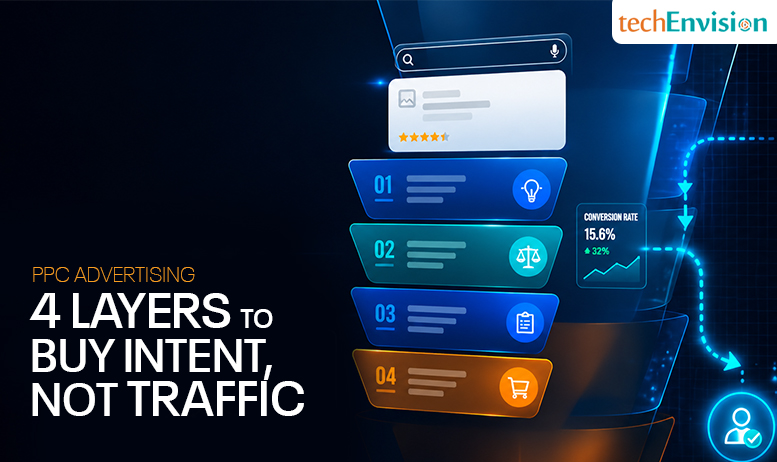
PPC Advertising: 4 Layers to Buy Intent, Not Traffic
TL;DR: PPC advertising doesn’t buy clicks. It buys intent. The strongest paid accounts stack four layers, search, social, retargeting, and shopping ads, then judge every rupee by CTR, CPC, CPA, and ROAS. Get the sequence right and your paid media pays for itself.
“Turn on ads, leads will come.” We hear that line every week. It’s wrong. PPC advertising rewards intent, not budget, and most accounts bleed money because they treat paid ads as a standalone trick instead of one part of a full-funnel marketing system. At TechEnvision, we’ve run paid campaigns for 15+ years and 1000+ happy clients across India, from local repair shops to fast-growing e-commerce brands. Here’s the hard truth we tell every one of them: a click is not a customer. This guide breaks down the four layers of a paid funnel, the four numbers that actually matter, and how to stop torching your ad budget on traffic that never converts.
What is PPC advertising?
PPC advertising, short for pay-per-click marketing, is a model where you pay a small fee each time someone clicks your ad. Instead of earning visits organically, you buy placement on platforms like Google Ads, Bing, and social feeds, and you pay only for the click, not the impression.
The 4 layers of PPC advertising
Most people run one layer and wonder why results stall. A real funnel needs all four.
1.Search ads
These catch people mid-decision. Someone types “best CRM for small business” or “AC repair near me.” In those three seconds, they’re already a buyer. Search ads on Google and Bing put you in front of that intent right now. SEO finds them later. PPC finds them today.
2.Social ads
Instagram, Facebook, LinkedIn, YouTube. Here you reach people who fit your profile even before they’ve searched. Good for demand you have to create, not just capture.
3.Retargeting
Most first-time visitors leave without buying. Retargeting brings them back. That abandoned cart, that half-read landing page, this layer nudges them to finish what they started.
4.Shopping and app ads
Image, price, offer, right in the results. For online stores and app installs, this layer does the heavy lifting because it shows the product before the click ever happens.
Read the numbers, not the adjectives
Vanity dashboards lie. Four metrics tell the truth:
CTR (click-through rate): did people even notice the ad?
CPC (cost per click): what one click costs you
CPA (cost per acquisition): what one actual customer costs you
ROAS (return on ad spend): revenue earned for every ₹1 spent
Here’s a real one. Spend ₹50,000, earn ₹2,00,000, that’s 4x ROAS. The campaign works. Now flip it. ₹50,000 spent, 200 clicks, zero sales. Traffic is working. The business isn’t. That gap is where most budgets quietly die.
PPC vs SEO: which finds the buyer first?
Both matter. They just run on different clocks.
PPC advertising
Speed: leads from day one
Cost: you pay per click, ongoing
Best for: launches, offers, fast lead generation
SEO
Speed: a marathon, usually 90 days or more
Cost: heavier upfront effort, then compounding returns
Best for: durable organic traffic and topical authority
Truth is, you need both. PPC is a sniper. SEO is the long game, and in 2026 that game includes ranking on Google and AI engines like ChatGPT. Get the sequence wrong and the budget burns before the rankings ever arrive.
How to set up a PPC campaign that doesn’t burn budget
Start with keyword research. Match search intent before you write a single ad.
Pick one layer to lead. Usually search ads for high-intent queries.
Build a tight landing page. One offer, fast load, one clear next step. Slow pages leak leads like a bucket with a hole in it.
Set up conversion tracking first. No tracking, no truth.
Launch small, read your CPA and ROAS, then scale only what pays.
Add retargeting once you actually have traffic to chase.
What real campaigns look like
A local service business fills its calendar with “near me” search ads while local SEO builds quietly in the background.
An e-commerce store cuts wasted spend by pausing high-CPC, zero-sale keywords, then rebuilds on a store engineered to convert instead of just collect clicks.
A fashion startup pairs paid social with organic, the same approach we used to scale a luxury label from invisible to in-demand in three months.
A slow site gets fixed, Core Web Vitals cleaned up, and the same ad budget suddenly converts better because the page finally loads.
We’ve built this playbook for hundreds of accounts. If you want it run for you, our pay-per-click services team handles setup, tracking, and scaling from day one.
Challenges and solutions
High spend, low ROI. Usually a targeting or landing-page problem, not a bidding one. We audit intent match first, then tighten the funnel around one clear action.
Traffic that never converts. Often a leaky store, not a lead problem. Paid clicks land, then bounce. Fixing the UX gaps that stall e-commerce sales usually recovers more revenue than raising the ad budget ever would.
Slow, unmaintained sites. They drain paid clicks fast. Our website maintenance keeps load times sharp so your ad budget isn’t paying for bounces.
Conclusion
PPC advertising isn’t magic. It’s math, plus intent, plus a page that actually converts. Stack the four layers, watch CPA and ROAS instead of vanity clicks, and let SEO carry the long game beside it. We’ve watched too many businesses pour money into traffic that looks busy and sells nothing. At TechEnvision, we build paid campaigns that answer to revenue, not applause. Ready to make every rupee accountable? Let’s map your funnel and put your budget where the buyers already are.
FAQs
Question: How does PPC advertising actually work?
Ans: You bid on keywords or audiences, your ad enters an auction, and you pay only when someone clicks. Platforms rank ads by bid and quality, so a relevant ad with a strong landing page often pays less per click than a sloppy, off-target one.
Question: What is a good ROAS for a PPC campaign?
Ans: Many businesses treat 4x ROAS as healthy, meaning ₹4 back for every ₹1 spent. But “good” depends on your margins. A high-margin service can profit at 2x, while a thin-margin store might need 6x or more to stay ahead.
Question: What is the best PPC strategy for a small business?
Ans: Start narrow. Pick one high-intent keyword group, one tight landing page, and one clear offer. Track CPA from day one, then scale only what converts. Small, measured tests beat big blind launches every single time.
Question: PPC vs SEO, which should I choose?
Ans: Both, in sequence. PPC delivers leads now while SEO compounds over months. If cash flow needs speed, start with PPC advertising, then reinvest the early wins into content and SEO for lasting organic traffic.