
Machine Learning in Education: Building Real-World Skills
Here’s the truth about modern careers: a diploma alone doesn’t cut it anymore. You’ve likely seen it firsthand. Employers no longer want proof you sat through a class they want proof you can actually do the work. They ask for portfolios, verified competencies, and hands-on experience.
If you’ve ever finished a semester-long course and wondered how it connects to your next job, you’re not alone. That friction is real, and it’s costing students time, money, and confidence.
That’s where machine learning in education changes the game. We’re not talking about replacing teachers with algorithms. We’re talking about using data to align what you learn with what the market actually demands. Think adaptive learning paths, instant feedback loops, and career mapping that updates in real time. Let’s break down how it works in practice and how you can use it to build skills that actually get hired.
How Machine Learning in Education Maps Classes to Real Jobs
Traditional degree programs move in straight lines. You take Course A, then Course B, then Course C. The industry can shift twice along the way, and the curriculum rarely notices.
Machine learning flips that model. Algorithms analyze years of enrollment data, graduation rates, and job placement records to identify which course combinations actually lead to employment. For example, researchers at UC Berkeley developed a system that scans a decade of student histories to recommend course sequences based on specific career goals. Want to break into data science? The system might suggest a blend of statistics, Python, and behavioral economics because that’s exactly what past students who landed those roles took.
What this means for you:
- Skip the filler electives and focus on high-ROI skills
- Get a clear, data-backed roadmap instead of guessing your next step
- Accelerate project completion (one training partner saw capstone timelines drop by 30% after switching to ML-mapped paths)
This approach transforms a confusing course catalog into a strategic skill-building plan. You stop collecting credits and start collecting competencies that show up in interviews.
Real-Time Feedback That Actually Closes Skill Gaps
Waiting three weeks for a midterm grade does nothing for your progress. By the time you see the score, you’ve already moved on to the next module. The learning loop stays broken.
Machine learning fixes this with continuous, adaptive assessment. Platforms like ALEKS don’t dump a single final exam on you. Instead, they probe what you know and don’t know in real time. The moment the system detects a shaky foundation, it serves targeted practice before advancing you further.
Here’s how it works in practice:
- You attempt a concept check or coding exercise
- The algorithm identifies the exact gap (e.g., struggling with recursion)
- It isolates the weakness and drops in micro-lessons or drills
- You progress only after demonstrating mastery
No more failing an entire module over one weak spot. You get a transparent, benchmark-aligned map of your proficiency that updates as you learn. This is the core of competency-based education—and it’s proving far more effective than time-based grading.
How Machine Learning Differs from Traditional Learning
Traditional education follows a fixed, linear path: you complete courses on a set schedule, receive delayed feedback, and earn grades that rarely reflect real-world readiness. Machine learning flips this model entirely.
Instead of a one-size-fits-all approach, adaptive systems personalize pacing so you advance only when you’ve mastered a concept. Feedback shifts from weeks-long delays to instant, concept-specific guidance that targets exactly what you’re missing. Course pathways become dynamic and career-aligned, pulling from live labor market data rather than static syllabi. And instead of letter grades, your progress is measured by verified competencies exactly what hiring managers look for.
This isn’t just faster learning. It’s learning that actually translates to career outcomes, reduces wasted time on irrelevant coursework, and gives you transparent proof of what you can do.
Keeping Students Engaged: Personalization That Works
Personalization isn’t just about handing you a different video. It’s about matching the material to how you actually learn and catching you before you disengage.
Modern ML education tools track interaction patterns, time-on-task, and error frequency. When you’re stuck, the system adjusts the difficulty. When you’re ahead, it increases complexity or shifts formats. Some platforms even flag early signs of burnout, giving instructors a heads-up to intervene while there’s still time.
More importantly, AI connects your coursework to live labor market data. It scans thousands of job postings, tracks emerging industry trends, and highlights which skills are gaining demand before you graduate. You’re not shooting in the dark. You’re investing your time in areas that pay off.
Key engagement drivers powered by ML:
- Dynamic difficulty adjustment based on performance
- Format switching (video, interactive quiz, simulation) to match learning style
- Proactive alerts for instructors when students show drop-off patterns
- Real-time skill-to-job matching updates
The Human Element: Where AI Stops and Teaching Begins
Here’s the catch: technology has hard limits. AI is excellent at drilling math, grammar, coding syntax, and structured skill pathways. It’s terrible at teaching creativity, ethical judgment, and complex problem-solving.
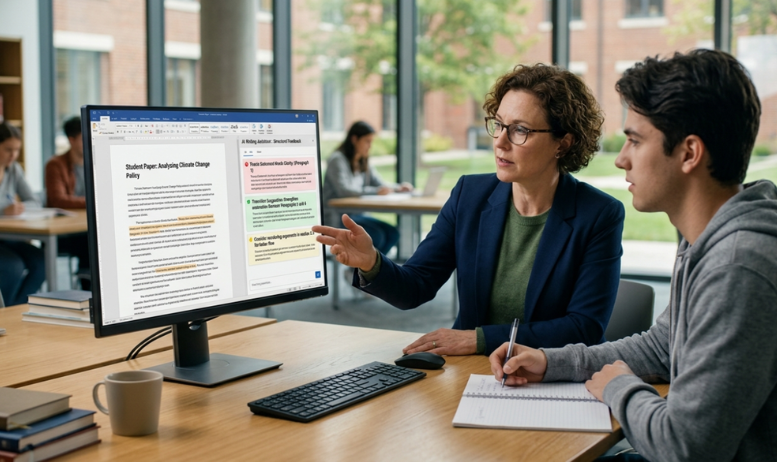
As MIT’s Bernhardt Trout notes, algorithms can’t decide what’s right or wrong. They can show you the landscape, but they won’t guide you through a debate on moral trade-offs or help you navigate ambiguous workplace dynamics. At Carnegie Mellon, ML tools help students swap draft papers and check structural flow but the real critique? That still comes from experienced instructors.
The most successful programs use AI to handle the heavy data lifting. Grading, pathway optimization, and gap identification happen automatically. That frees teachers to do what only humans can: mentor, challenge assumptions, build communication skills, and foster critical thinking.
AI supports the classroom. It doesn’t replace the people in it.
Machine Learning in Education: Frequently Asked Questions
Q: How does machine learning personalize student learning?
A: ML algorithms analyze your performance data in real time, adjusting difficulty, pacing, and content format based on how you learn. If you struggle with a concept, the system serves targeted practice before moving forward, ensuring mastery over memorization.
Q: Does machine learning in education replace teachers?
A: No. AI handles data-heavy tasks like grading, skill mapping, and adaptive feedback. Teachers focus on mentorship, ethical reasoning, complex problem-solving, and classroom engagement areas where human judgment remains irreplaceable.
Q: What real-world skills do employers verify through AI-driven tools?
A: Employers increasingly look for competency-based proof: portfolio projects, verified technical skills (e.g., Python, data analysis, UX design), and adaptive problem-solving. ML platforms track and certify these outcomes, giving you transparent, industry-aligned proof of ability.
Q: Is adaptive learning better than traditional coursework?
A: For skill acquisition and career readiness, yes. Adaptive learning closes knowledge gaps faster, aligns directly with job market demand, and measures mastery instead of time spent in class. Traditional models excel in foundational theory, but ML-driven paths win on speed, relevance, and employability.
What You Should Do Next: Verify Your Skills
Machine learning in education is shifting the entire system from “did you show up?” to “what can you actually do?” For you, that means faster skill building, clearer career visibility, and proof employers actually trust. For schools and training programs, it means provable outcomes that reduce hiring risk.
Start with three quick steps:
- Audit your current learning tools: Do they give instant feedback or delayed grades?
- Check your skill gaps: Use a competency checklist to see what’s missing before your next application
- Prioritize mastery over hours: Choose platforms that verify outcomes, not attendance
Skills are the new currency. Make sure you’re spending your time on what actually verifies.