
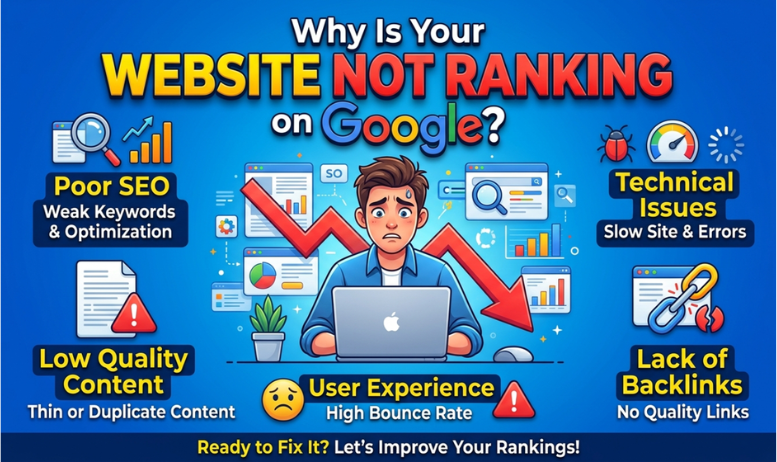
Why Your Website is Not Ranking on Google (Even After SEO)
You researched keywords, published blogs, and optimized your website. Still, your website is not ranking on Google.
This is one of the biggest frustrations for businesses, bloggers, and marketers today. Many people believe SEO is only about adding keywords and publishing content. But modern SEO has changed completely.
Google now focuses more on user experience, search intent, content quality, and website authority. If your rankings are stuck, there are usually a few important reasons behind it.
Let’s understand the real problems that stop websites from ranking.
❌ 1. You Are Targeting the Wrong Keywords
Many websites try to rank for highly competitive keywords. These keywords may have huge search volume, but they are often difficult to rank for.
For example, trying to rank for a broad keyword like “SEO” is extremely hard because large websites already dominate those results.
Instead, focus on long-tail keywords with clear search intent.
Example:
- Broad keyword: “SEO”
- Better keyword: “SEO tips for small businesses”
Long-tail keywords usually attract more targeted visitors and improve conversion rates.
✅ What You Should Do
- Use low-competition keywords
- Focus on user intent
- Research competitor keywords
- Target specific search queries
Choosing the right keywords is the foundation of successful SEO.
❌ 2. Your Content Lacks Depth
Google prefers detailed and valuable content. Short blogs with basic information usually struggle to rank.
If your article only explains surface-level points, users may leave quickly to search for better information elsewhere.
Modern SEO content should fully solve the reader’s problem.
High-quality content improves:
- User engagement
- Time on page
- Search visibility
- Website authority
✅ What You Should Do
Create content that includes:
- Clear headings
- Practical examples
- Actionable tips
- Updated information
- FAQs and solutions
Instead of writing multiple short blogs, focus on creating complete and useful articles.
❌ 3. You Have No Topical Authority
Publishing one blog post about SEO does not make your website an expert source.
Google prefers websites that consistently publish related content around one topic. This is called topical authority.
For example, if your website focuses on SEO, you should also create blogs about:
- Technical SEO
- On-page SEO
- Keyword research
- Link building
- Local SEO
This helps search engines understand your expertise.
✅ What You Should Do
Use a content cluster strategy.
Create multiple related articles and connect them using internal links. Internal linking helps:
- Improve crawlability
- Increase user engagement
- Strengthen topic relevance
- Improve rankings
Consistency is important for building authority.
❌ 4. Your Website is Too Slow
Website speed is now a direct ranking factor.
If your website takes too long to load, users leave quickly. A slow website creates a poor user experience and increases bounce rates.
Slow websites often lose rankings even if the content is good.
Common reasons for slow speed include:
- Large image sizes
- Poor hosting
- Too many plugins
- Heavy scripts
✅ What You Should Do
Improve speed by:
- Compressing images
- Using caching plugins
- Reducing unnecessary scripts
- Choosing fast hosting
- Using a CDN
A faster website improves both SEO and user experience.
❌ 5. You Do Not Have Quality Backlinks
Backlinks are still one of the strongest ranking signals in SEO.
When trusted websites link to your content, Google sees your website as more reliable and authoritative.
However, quality matters more than quantity.
Spammy backlinks can actually harm your rankings.
✅ What You Should Do
Focus on earning backlinks through:
- Guest posting
- Helpful content
- Industry collaborations
- Business directories
- Digital PR strategies
Strong backlinks improve trust and ranking potential.
❌ 6. Ignoring Modern SEO Changes
SEO is evolving rapidly because search behavior is changing.
Today, Google shows:
- AI-generated answers
- Featured snippets
- Voice search results
- Video content
- People Also Ask sections
Traditional SEO methods alone are no longer enough.
✅ What You Should Do
Optimize your content for modern search results by:
- Writing direct answers
- Using proper headings
- Adding FAQ sections
- Improving mobile experience
- Creating original content
Websites that adapt to new SEO trends perform better in search rankings.
💡 Final Thoughts
SEO is not about publishing more content randomly.
It is about creating the right content with the right strategy.
If your website is not ranking, focus on:
- Better keyword targeting
- High-quality content
- Website speed
- Strong backlinks
- Topical authority
SEO takes time, consistency, and continuous improvement. When done correctly, it can bring long-term traffic and business growth.