
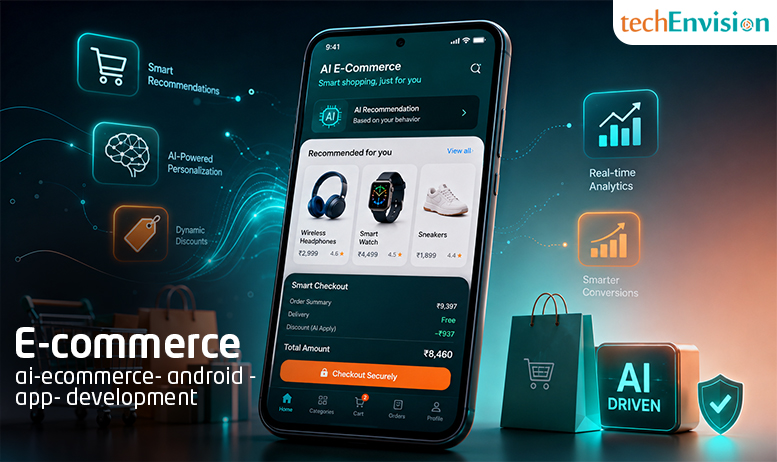
AI-Powered Android App Development in 2026: Build Smarter Apps That Grow Your Business
Android application development in 2026 blends native performance with AI features like on-device ML, predictive UX, and Jetpack Compose UIs. Done right, it turns an app into a revenue engine. TechEnvision builds custom, AI-powered Android apps that scale with your business.
The Business Case Nobody Reads First
Most apps die quiet deaths. Not because the idea was bad. Because the build was slow, the UX felt clunky, and nobody planned for scale. Android application development isn’t a checkbox anymore. It’s a growth lever. We’re TechEnvision, a digital and IT-services agency with 15+ years behind us and 1000+ happy clients, and we’ve watched this play out hundreds of times. A founder ships fast, gets traction, then the app buckles at 10,000 users. Here’s the thing: AI-powered Android apps change that math. They ship smarter, personalize faster, and cut the manual work that eats your margins. This is what actually moves traffic, leads, and sales.
What is Android application development?
Android application development is the process of designing, coding, testing, and shipping software that runs on Android devices. It uses languages like Kotlin, tools like Android Studio, and UI frameworks like Jetpack Compose to build apps distributed through Google Play or private channels.
Why AI Changes the Android Game in 2026
AI stopped being a bolt-on. It’s baked into the build now. On-device machine learning means your app can recognize images, predict user intent, and personalize screens without a round-trip to the server. Faster. Cheaper. Private.
Google’s own tooling pushes this hard. According to Google’s Android developer guidance, on-device ML through ML Kit and Gemini Nano lets apps run inference locally, cutting latency and protecting user data. That’s a real edge for e-commerce and fintech apps where speed and trust decide the sale.
What AI-powered Android apps do well:
- Predict, not react. Recommend products before users search.
- Automate support. In-app assistants that actually resolve tickets.
- Personalize UX. Layouts that adapt to how each user behaves.
- Cut fraud. On-device anomaly detection at checkout.
Look, the tech is only half of it. The other half is knowing where to spend the budget. An app without a demand plan is a shop with no signage. That’s where our digital marketing services pull the weight, driving installs, retention, and leads once the build is live.
How to Build Scalable Android Apps in 2026
Scale isn’t luck. It’s architecture decided on day one. Here’s the sequence we use on client builds:
- Map the intent. Define what the app must do for the user, and what it must do for revenue. Two different lists.
- Pick native where it counts. Kotlin plus Jetpack Compose app development for the core. Cross-platform only where speed-to-market beats performance.
- Design for state. Clean architecture, modular code, so features don’t collapse into each other later.
- Bake in AI early. Decide on-device vs. cloud inference before you write the feature, not after.
- Test on real devices. Emulators lie about performance. Cheap phones tell the truth.
- Ship, measure, iterate. Track conversion rate and retention from launch, not month three.
Skip step one and you’ll rebuild by step six. We’ve seen it.
Native vs. Cross-Platform: A Straight Comparison
Neither is “right.” It depends on your stage. Native Android, built with Kotlin and Jetpack Compose, gives you the best performance, full access to on-device AI, and lower long-term cost at scale. The trade-off is a slower time to market. It’s the smart call for growth-stage products.
Cross-platform, on the other hand, gets you live faster and suits tight budgets. Performance is good but not flawless, and on-device ML access is only partial through plugins. Maintenance costs tend to climb over time. It’s a fair choice for MVPs and early validation.
So a startup testing an idea might go cross-platform. A retailer processing thousands of orders a day should go native.
Use Cases: What This Looks Like in Real Businesses
- E-commerce store. An AI recommendation engine on the product screen lifts average order value and cuts wasted ad spend. If you’re weighing a build partner, our take on why we’re one of the best e-commerce development companies in India for 2026 walks through how we approach these builds.
- Local service business. A booking app with predictive scheduling fills empty slots and reduces no-shows.
- Fashion and retail brands. App traffic means nothing without discovery. We scaled a luxury label from invisible to in-demand in three months, and the full e-commerce SEO case study shows the exact playbook.
- Field-ops company. Offline-first Android apps that sync when signal returns, no lost data at the warehouse.
We handle these end to end. If you want the full scope, our custom Android app development services page lays out how we work.
Challenges and How We Handle Them
Slow, bloated apps. Users bounce after a few laggy seconds. We audit the codebase, trim dependencies, and optimize rendering so the app feels instant.
High build cost, unclear ROI. Ambition outruns budget fast. We scope in phases, ship a lean core first, then expand once the numbers justify it. No guessing.
No plan for scale. The app that works at 500 users chokes at 50,000. We design the architecture and backend for the traffic you want, not the traffic you have today.
Build Something That Actually Grows
An Android app is only as good as the strategy under it. Get the architecture, the AI features, and the roadmap right, and it earns its keep for years. Get them wrong, and it’s a sunk cost with an icon. As a mobile app development company with 1000+ clients behind us, TechEnvision builds custom Android app development for startups and established brands that need results, not just a build. Want to talk through your idea? We’re ready when you are.
FAQs
Question: How much does Android application development cost in 2026?
Ans: Costs vary by complexity. A simple app may start in the low thousands. A scalable, AI-powered Android app with custom features runs higher. We scope in phases so you fund what delivers ROI, not vanity features.
Question: How long does it take to build a custom Android app?
Ans: A focused MVP typically takes 8 to 16 weeks. Complex apps with AI, integrations, and heavy backends take longer. Honest timelines beat rushed launches, and rushed apps usually get rebuilt anyway.
Question: Is Jetpack Compose better than the old XML approach?
Ans: For most 2026 builds, yes. Jetpack Compose app development speeds up UI work, reduces boilerplate, and makes complex, dynamic screens easier to maintain. It’s Google’s recommended toolkit for modern Android UIs.
Question: Do I need native development or is cross-platform fine?
Ans: It depends on your stage. Cross-platform suits fast MVPs on tight budgets. Native Android suits performance-heavy, growth-stage products, especially those using on-device AI and processing high transaction volumes.