
AI vs. ML vs. Deep Learning: Stop Pretending You Know the Difference
Look, if you’ve sat through a tech meeting in the last five years, you’ve heard these terms thrown around like confetti. Someone says “AI.” Someone else corrects them with “Machine Learning.” Then a third person chimes in with “Deep Learning.”
Everyone nods. Nobody actually knows what’s going on.
Here’s the thing: you don’t need a PhD to get this. You just need someone to cut through the buzzwords.
We’ve seen this happen hundreds of times. Clients come to us wanting “AI solutions,” but what they actually need is a simple script. Or they want “Deep Learning,” but their data isn’t even organized yet.
It’s not about sounding smart. It’s about knowing which tool fixes your problem.
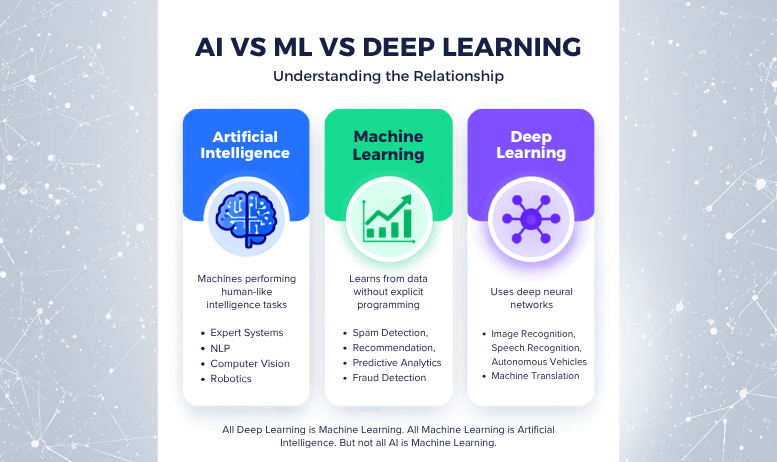
🤖 Artificial Intelligence (AI): The Big Umbrella
Think of AI as the whole pie.
It’s any technique that lets a computer mimic human thinking. That’s it. It doesn’t have to be smart. It just has to act like it.
You’ve already used AI today.
- Siri or Alexa: They hear you and respond. That’s AI.
- Self-driving cars: They see the road and make decisions. That’s AI.
- Spam filters: They decide what email hits your inbox. That’s AI.
If a machine is doing something that usually requires a human brain, it’s AI.
📊 Machine Learning (ML): The Worker Bee
Now, zoom in. ML is a slice of that AI pie.
Here’s the difference: Traditional AI follows strict rules written by humans. Machine Learning learns from data instead of following a rulebook.
You don’t tell it exactly what to do. You show it examples, and it figures out the pattern.
Real-world example: Think about Netflix. They don’t have a person manually picking movies for you. The ML algorithm looks at what you watched, compares it to millions of other users, and predicts what you’ll like next.
It gets better the more you use it. That’s the key. ML improves over time.
🔥 Deep Learning (DL): The Heavy Lifter
Now zoom in even closer. Deep Learning is a specialized slice of Machine Learning.
This is where things get serious. DL uses artificial neural networks—layers of algorithms stacked on top of each other to solve really complex problems.
It needs massive amounts of data and serious computing power. But when it works, it’s scary good.
Where you see this:
- Face Recognition: Unlocking your phone with your face.
- ChatGPT: Generating human-like text.
- Medical Imaging: Spotting tumors in X-rays better than doctors.
If ML is a student reading a textbook, Deep Learning is a researcher running simulations in a lab.
💡 The Cheat Sheet
Still fuzzy? Here’s the formula we use when clients get stuck:
- AI = The Goal (Think like a human)
- ML = The Method (Learn from data)
- DL = The Engine (Neural networks for hard stuff)
Or even simpler:
- 🤖 AI = Think
- 📊 ML = Learn
- 🔥 DL = Learn Deeply
Why This Actually Matters to You
You might be wondering, “Do I really need to know this?”
Yes. Because if you’re buying tech, hiring a team, or planning a product, the costs vary wildly.
Building a simple AI rule-based chatbot? That’s relatively cheap. Training a Deep Learning model to recognize emotions in voice calls? That’s expensive and data-heavy.
We’ve seen companies burn budgets because they asked for “Deep Learning” when a simple ML model would have done the job in half the time.
Don’t let the jargon drive the bus. Let the problem drive the solution.