
Digital Marketing Services: Marketing vs Branding and Why Businesses Need Both for Digital Growth
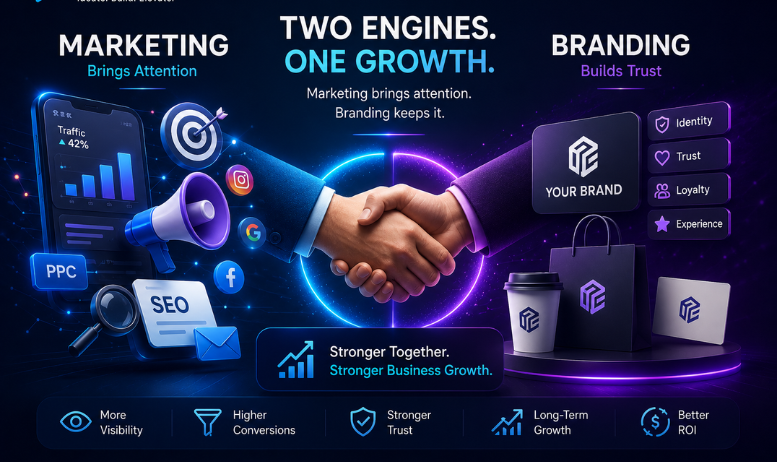
Marketing brings attention. Branding keeps it. If your ads get clicks but people don’t remember you, or your content looks polished but nobody finds it, you don’t have a growth strategy, you have a gap. Digital Marketing Services work best when marketing and branding are built together, not treated like rivals.
Introduction
Two strong engines beat one. Every time. Digital Marketing Services help you get found, start conversations, and drive traffic, but branding is what makes people trust you enough to buy, come back, and refer others. We’re TechEnvision, and after 15+ years, 1000+ happy clients, and plenty of campaigns that looked great on paper but leaked money in practice, we’ve seen the same pattern: businesses chase visibility, then wonder why loyalty never shows up. This article clears that up. We’ll break down the real difference between marketing and branding, show how they work together, and explain how to use both for business growth without burning budget on noise.
What is marketing and branding?
Marketing is the set of actions used to attract attention, generate traffic, and convert interest into leads or sales. Branding is the identity, trust, and perception people attach to your business over time. One pulls people in. The other gives them a reason to stay.
Marketing brings attention
Marketing is the loud part. It includes SEO, PPC, social media, email, and content that helps people discover your business. If your site is buried on page two, your CTR is weak, or your funnel has more holes than a tired bucket, marketing is the toolset that fixes the visibility problem.
What marketing does well
- Drives immediate traffic through ads and campaigns.
- Improves search visibility through SEO and content.
- Creates measurable actions like clicks, leads, and sales.
- Supports short-term promotions and launches.
But here’s the catch. Marketing without branding can get attention and still feel forgettable. People click, skim, and vanish. Seen it many times.
Branding builds trust
Branding is not just a logo or color palette. It’s your tone, your promise, your customer experience, and the feeling people get when they interact with your business. Strong branding lowers hesitation. It makes your offer feel safer, cleaner, and more credible.
According to Google’s own guidance on building helpful, trustworthy content, consistency and usefulness matter because people respond better to brands that feel reliable and clear. That is not fluff. That is conversion psychology with receipts.
What branding does well
- Builds recognition across channels.
- Improves customer retention and repeat purchases.
- Supports trust during high-consideration buying.
- Makes your marketing easier to remember and share.
Think of it like a shop with good signage versus a shop with no sign at all. You can have the best products inside, but if people don’t know who you are, they keep walking.
Why you need both
Marketing without branding is expensive. Branding without marketing is invisible. Businesses that want Business Growth Through Digital Marketing need both working in sync, because traffic alone doesn’t pay the bills. Trust does.
How they work together
- Marketing creates awareness.
- Branding turns attention into belief.
- Marketing brings users back.
- Branding makes them stay.
- Together, they improve conversion rate and customer lifetime value.
That’s the real play. Not either/or. Both. Otherwise, your funnel leaks at the top and again at checkout.
Marketing vs Branding
- Goal
Marketing: Drive attention and conversions.
Branding: Build trust and loyalty. - Timeframe
Marketing: Short to medium term.
Branding: Medium to long term. - Channels
Marketing: SEO, PPC, social media, email campaigns.
Branding: Messaging, brand identity, customer experience, reputation building. - KPI Focus
Marketing: Traffic, leads, ROAS, CPC, conversion rate.
Branding: Brand recall, customer retention, trust, repeat sales. - Outcome
Marketing: Creates more reach and attracts potential customers.
Branding: Creates stronger preference and long-term customer relationships.
If you’re comparing Online Marketing Solutions with brand work, the mistake is treating one as a substitute for the other. They solve different problems. Same business goal, different jobs.
How to build both
A smart growth plan starts with search intent, then layers identity on top. That’s how Digital Marketing Services stop being random activity and start becoming a system.
Use this approach
- Start with keyword research and audience intent.
- Build landing pages that answer the real question fast.
- Keep messaging consistent across site, ads, and social.
- Use one visual and verbal style everywhere.
- Track what converts, not just what gets clicks.
According to Google Search Central, helpful content and strong page experience support better visibility and user satisfaction. That means your pages need to load fast, read clearly, and match intent. Fancy copy won’t save a page that confuses users.
How to do it step by step
- Define the brand
Clarify your value proposition, tone, promise, and customer promise. If this sounds vague, that’s because weak brands are vague. Fix that first.
- Build demand with marketing
Run SEO, paid search, social campaigns, and email around that message. Use one core idea across channels so users don’t feel like they’ve landed in three different businesses.
- Measure the handoff
Track traffic, click-through rate, conversion rate, and retention. If marketing performs but retention drops, branding is weak. If branding feels strong but no one finds you, marketing is weak.
- Tighten the loop
Use customer feedback, reviews, and behavioral data to refine both sides. This is where most teams get lazy. They launch, then stop listening. That’s where growth slows.
Use Cases / Real Results
We see this all the time in client work at TechEnvision.
- A local business needed visibility fast, so we paired SEO with a cleaner brand story. Rankings improved, but more importantly, the business started getting calls from better-fit leads.
- An e-commerce store had strong ads but poor trust signals. We refined messaging, tightened product pages, and reduced wasted PPC spend through better landing page alignment.
- A startup wanted authority in a crowded space. We combined SEO content with clear brand positioning, and their topical authority grew without sounding like every other “thought leader” on the internet.
- A service business with a slow, clunky site lost leads daily. After fixing the experience and the messaging, inquiries became more consistent. Less chaos. More conversions.
If you’re planning a bigger growth push, our Digital Marketing Services page shows how we connect SEO, PPC, content, and strategy into one system.
Challenges & Solutions
The first problem is thin content. It doesn’t rank well, and it doesn’t persuade well either. We solve that by matching content to intent, improving structure, and building topical clusters that support authority.
The second problem is ad waste. Businesses often spend on PPC before their brand message is clear. That’s like pouring water into a cracked jar. We fix that by tightening positioning, improving landing pages, and aligning creative with real buyer intent.
The third problem is inconsistency. Different teams publish different messages, and the audience gets whiplash. We solve that with a consistent content framework, shared brand voice, and channel-specific execution.
Conclusion
Marketing and branding are not rivals. They’re teammates. One gets you discovered. The other gets you remembered. If your growth has stalled, the issue is usually not “more traffic.” It’s a broken handoff between visibility and trust. TechEnvision helps businesses fix that with full-stack digital and IT services built for traffic, leads, and sales not vanity metrics. Clean strategy. Clear execution. Fewer dead ends.
FAQs
Q: What is the difference between marketing and branding for businesses?
A: Marketing attracts attention and drives action. Branding shapes how people perceive and trust your business. Marketing gets the first click. Branding influences the second visit, the purchase, and the referral.
Q: How do digital marketing and branding work together?
A: Digital marketing brings people to your site or channels. Branding makes them feel confident enough to stay, buy, and return. When both are aligned, your conversion rate and retention usually improve because the message feels consistent.
Q: Can a business grow with only marketing?
A: Yes, but growth is often unstable. You may get traffic, leads, or sales for a while, but without branding, trust and loyalty stay weak. That usually leads to higher acquisition costs and lower repeat business.
Q: What is the best way to balance marketing and branding?
A: Start with a clear brand promise, then run marketing around it. Use one message, one visual direction, and one customer experience across channels. That’s the cleanest path for stronger recall and better business growth.