
Why Your Sales Are Stalling: The Truth About the Marketing Funnel strategy (And How to Fix It)
Most people think marketing is simply about selling; they launch an ad, drive traffic, and expect immediate revenue. When it doesn’t happen, they panic and increase their budget. Yet, without a clear marketing funnel strategy to guide prospects, that extra spending is often wasted.
Here’s the thing: real marketing works like a funnel, not a vending machine.
If you try to marry someone on the date you’re going to get rejected. That’s what happens when businesses skip building a relationship and go for the sale. They make people skeptical, not excited.
If your conversion rates are flatlining it’s likely not your product. It’s your process. Let’s break down how real marketing funnels work and why trust converts faster than promotion every time.
The Myth of the “Instant Sale”
We live in a world where people want things fast. They want same-day delivery and immediate answers. Businesses think their customers feel the way about buying.
They don’t.
Today people are skeptical. They’ve been burned by tactics and empty promises. Before they hand over their credit card they need to know: can I trust you?
When you skip building a relationship you trigger a defense mechanism. The result? High bounce rates, abandoned carts and wasted ad spend.
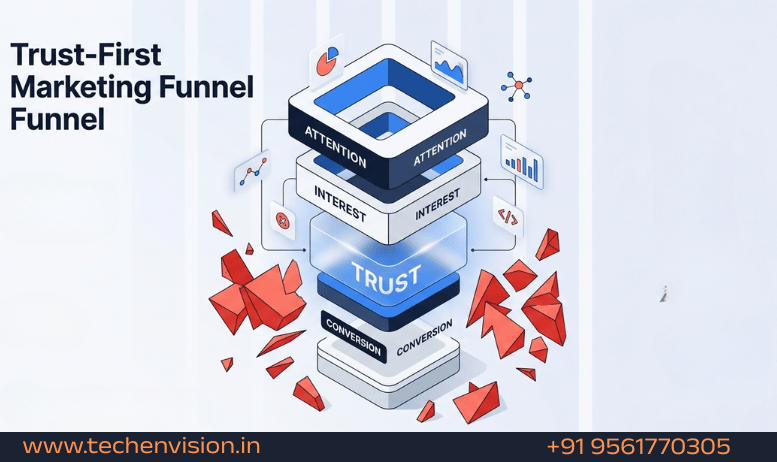
The 4-Stage Funnel That Actually Works
1.Attention: The Discovery Phase
Goal: Get them to notice you exist. This is the part of the funnel. Your audience doesn’t know they have a problem yet or they don’t know you have the solution. Your job isn’t to sell; it’s to grab their attention with value.
What works: posts, viral hooks solving a small problem.
What fails: sales pitches, “Limited Time Offer” banners.
Pro Tip: if you run a business like Techenvision, your attention-grabber shouldn’t be “Hire us.” It should be “Why 90% of e-commerce sites lose money in the 3 months.”
2.Interest: The Investigation Phase
Goal: Get them to check your content, website or services. Once you have their attention they move to interest. They visit your profile. Scan your website asking, “Is this relevant to me?” This is where your content strategy shines. You need to prove you understand their pain points better than they do.
Actionable Step: create “To” guides, case studies or behind-the-scenes looks. For clients like those looking for investment casting equipment this means detailed specs on durability rather than just a price list.
3.Trust: The Relationship Phase
Goal: prove you are the choice. This is the stage most businesses skip. They rush from “Interest” straight to “Conversion.” Big mistake. Trust is built through consistency. It happens when you show up repeatedly with information and transparent branding. In today’s market trust converts faster than promotion. A warm lead who trusts you will buy at price. A cold lead who doesn’t will haggle you down or ghost you.
4.Conversion: The Decision Phase
Goal: make the purchase easy and risk-free. After the first three stages are solidified does the actual sale happen. By this point the customer has already decided to buy; they just need a nudge. Your call-to-action (CTA) shouldn’t be a plea. It should be a next step.
Selling First vs. Building Trust First: A Comparison
Here’s the difference between the way and the right way:
The “Sell Immediately” approach focuses entirely on transaction volume. It makes the customer feel pressured and skeptical. The result is usually a conversion rate with high churn.
In contrast the “Build Trust First” approach prioritizes establishing a relationship with the customer. By fostering connections and providing value upfront you’re more likely to see repeat business and a loyal customer base.
The “Trust-First” funnel focuses on relationship depth. It makes the customer feel understood and valued. This leads to conversion rates and repeat buyers.
When you look at the numbers the choice is clear. Chasing sales burns out your audience. Building trust creates an engine for growth.
Real-World Application: How to Build the Funnel Today
You don’t need a budget to implement this. You just need a shift in mindset. Here’s a practical roadmap:
- Audit your content: look at your 10 social media posts. How many were purely promotional? If it’s than 20%, pivot. Start sharing value.
- Optimize for consistency: show up consistently. Inconsistency kills trust.
- Create a “Nurture” sequence: don’t send a “Buy email immediately after a signup. Send a “Welcome” email, a “Value” email, then a “Story” email and finally the offer.
- Leverage social proof: testimonials, case studies and user-generated content are the ways to accelerate the “Trust” phase.
FAQ
Question: How long does it take to build trust in a marketing funnel strategy?
Answer: It varies by industry. For high-ticket items it can take weeks or months of engagement. For lower-cost items it might take a Day’s of retargeting.
Question: Can I still run sales ads?
Answer: Absolutely. Ensure your ads target people who have already engaged with your content (warm audiences) rather than cold audiences.
Question: What if my competitors are selling aggressively?
Answer: Let them. Aggressive selling often leads to refund rates and bad reviews. By focusing on trust’s you attract higher-quality customers who stay longer and refer others.
Stop Pushing Start Pulling
The biggest mistake businesses make today is treating marketing like a megaphone when it should be a magnet.
When you focus on attention, interest and trust before asking for the sale you stop chasing customers and start attracting them. You build a brand that stands out not because it shouts the loudest. Because it resonates the deepest.
At Techenvision we don’t just build websites; we engineer growth strategies based on these principles. From Strategy and Design to Development and Optimization we help brands, like yours turn visitors into advocates.
Visit www.techenvision.in ( https://www.techenvision.in/about-us/ ). Come in today to discover how our human-crafted data-driven approach can elevate your business. Let’s build something together.