
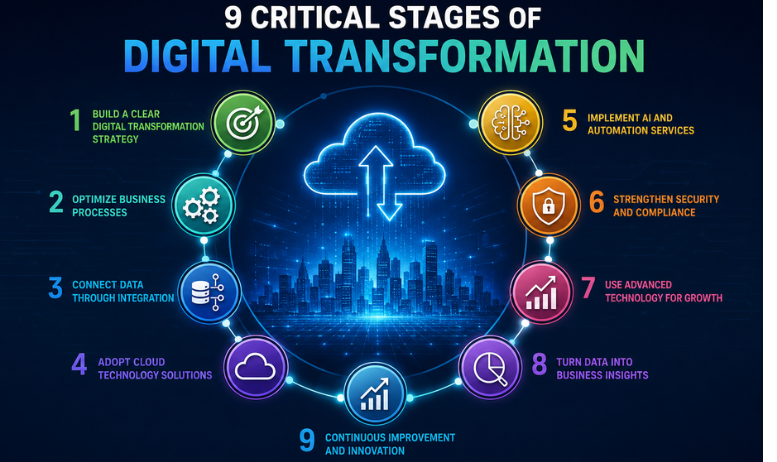
Digital Transformation Services: The 9 Critical Stages Behind a Successful Digital Evolution
Digital Transformation Services help businesses modernize operations through strategy, automation, cloud adoption, data management, and advanced technologies. Successful transformation is not about buying new tools first. It starts with fixing processes, connecting systems, securing data, and creating a roadmap that supports measurable business growth.
Introduction
9 out of 10 digital transformation projects fail before technology becomes the real problem. The reason? Businesses often invest in tools without fixing the foundation.
At TechEnvision, we believe effective Digital Transformation Services begin with understanding your business goals, operational gaps, and customer journey. With 15+ years of experience and 1000+ happy clients, we have seen one common pattern: companies grow faster when technology supports strategy, not when technology replaces strategy.
Modern organizations need connected systems, smarter workflows, better customer experiences, and reliable data. This article explains the nine stages businesses should follow to build a practical digital transformation roadmap.
What Are Digital Transformation Services?
Digital Transformation Services involve using digital technologies, improved processes, and data-driven approaches to redesign how a business operates and delivers value. These services combine automation, cloud technology, analytics, software solutions, and strategic planning to improve efficiency, decision-making, and customer experience.
9 Critical Stages of a Successful Digital Transformation Strategy
1.Build a Clear Digital Transformation Strategy
Every successful transformation starts with a clear direction.
A digital transformation strategy defines what your business wants to improve, which technologies support those goals, and how success will be measured.
Before selecting tools, we usually evaluate:
- Current website performance
- Existing software systems
- Customer acquisition process
- Data availability
- Operational bottlenecks
A simple example: a manufacturing company may not need an expensive AI system first. It may need better inventory tracking and connected reporting.
The foundation matters.
2.Optimize Business Processes Before Automation
Automation cannot fix a broken process.
Business Process Automation works best when repetitive tasks are already clearly mapped. According to Google’s productivity guidelines, businesses should improve workflows before implementing digital solutions.
Common opportunities include:
- Automated customer follow-ups
- CRM integrations
- Invoice processing
- Employee workflow management
Here’s the thing: adding automation to a confusing process only creates a faster confusing process.
3.Connect Data Through Integration
Disconnected data creates disconnected decisions.
Many organizations store information across multiple platforms. Sales data sits in one system, customer details in another, and marketing reports somewhere else.
Data integration creates a unified view.
Tools like GA4, Google Search Console, CRM platforms, and reporting dashboards help businesses understand:
- Where customers come from
- Which campaigns generate leads
- Which pages influence conversions
Good data creates better decisions.
4.Adopt Cloud Technology Solutions
Cloud adoption gives businesses flexibility, scalability, and easier collaboration.
Cloud Technology Solutions help organizations manage applications, storage, security, and remote operations without depending only on traditional infrastructure.
A practical timeline:
- Small businesses: 3–6 months for basic cloud migration
- Larger organizations: 6–18 months depending on complexity
But cloud migration is not just moving files online. Security, access control, backups, and performance planning matter.
5.Implement AI and Automation Services
AI is valuable when it solves real business problems.
AI and Automation Services can support:
- Customer support assistants
- Predictive analysis
- Content workflows
- Internal reporting
- Recommendation systems
The mistake many companies make? They chase AI trends before understanding their actual business needs.
A slow website with poor customer flow will not become successful just because AI is added.
6.Strengthen Security and Compliance
Digital growth creates more responsibility.
Businesses must protect customer information, internal systems, and digital assets.
Security improvements include:
- Regular software updates
- Access management
- Data encryption
- Website monitoring
- Security audits
A digital ecosystem without security is like building a modern office with an unlocked door.
7.Use Advanced Technology for Growth
Once the basics work, businesses can explore advanced solutions.
Businesses should choose technology based on their actual goals, not because a tool is trending. For example, a company looking for more qualified leads may need a combination of SEO and Data Analytics Solutions to understand customer behaviour and improve conversions.
A business struggling with repetitive manual tasks can implement Business Process Automation to improve operational efficiency and save time. Companies focused on improving customer experience can benefit from mobile app development, CRM integration, and personalized digital solutions.
For organizations aiming to increase online sales, e-commerce development solutions can help create better shopping experiences, improve customer journeys, and support revenue growth.
The technology should follow the business goal, not the opposite.
8.Turn Data Into Business Insights
Data Analytics Solutions help businesses understand performance beyond basic numbers.
Metrics like conversion rate, customer acquisition cost, ROAS, and user behaviour reveal what is actually working.
For example, GA4 can show whether website visitors are completing important actions or leaving before conversion.
Traffic is useful.
Revenue-focused traffic is better.
9.Continuous Innovation and Improvement
Digital transformation is not a one-time project.
Successful organizations regularly improve:
- Website experience
- Marketing campaigns
- Internal processes
- Customer journeys
- Technology adoption
According to Google Search Central, continuous improvement of content quality, user experience, and technical performance supports better search visibility.
Small improvements compound over time.
How Businesses Can Achieve Successful Digital Transformation
A practical roadmap looks like this:
- Audit current systems and processes.
- Define measurable business goals.
- Select suitable technologies.
- Improve workflows before automation.
- Track results using analytics.
- Continuously optimize performance.
At TechEnvision, our approach combines website development, SEO, digital marketing, IT solutions, and automation to help businesses create stronger digital ecosystems.
Explore our full range of solutions: https://www.techenvision.in/ (https://www.techenvision.in/)
Common Digital Transformation Challenges and Solutions
Problem 1: Technology Without Strategy
Many businesses purchase software but lack implementation planning.
Solution: Start with business objectives, customer needs, and measurable outcomes.
Problem 2: Poor Website and Digital Performance
A slow website can leak leads like a bucket with small holes.
Solution: Improve Core Web Vitals, technical SEO, landing pages, and conversion paths.
Problem 3: High Marketing Costs With Low Returns
Businesses often spend more on ads without understanding search intent.
Solution: Combine SEO, PPC analysis, keyword research, and conversion tracking.
Real-World Digital Transformation Use Cases
Businesses approach us with different challenges:
- A local business improving visibility through local SEO and Google Business optimization.
- An e-commerce company reducing wasted PPC spending through better targeting and landing page improvements.
- A startup building topical authority through SEO content clusters.
- Organizations improving customer experience through website development and automation.
Digital transformation looks different for every business.
The goal remains the same: better efficiency, stronger customer relationships, and sustainable growth.
Conclusion
Successful digital transformation does not begin with technology. It begins with clarity.
The right Digital Transformation Strategy combines processes, data, cloud systems, automation, and continuous improvement. Businesses that build the foundation first create stronger long-term results.
At TechEnvision, we help organizations turn digital challenges into practical growth opportunities through full-stack digital and IT solutions. Your transformation journey should solve real problems — not simply add more tools.
FAQs
- How long does digital transformation take?
Digital transformation timelines depend on business size, technology requirements, and existing systems. Small projects may take a few months, while enterprise-level transformations can take more than a year.
- Why are Digital Transformation Services important for businesses?
Digital Transformation Services help businesses improve efficiency, automate repetitive work, understand customer behaviour, and make better decisions using technology and data.
- What technologies support digital transformation?
Common technologies include cloud platforms, AI solutions, automation tools, analytics platforms, mobile applications, CRM systems, and integrated software solutions.
- Can small businesses implement digital transformation?
Yes. Small businesses can start with focused improvements like website optimization, automation, analytics tracking, and cloud-based tools before expanding into larger initiatives.