
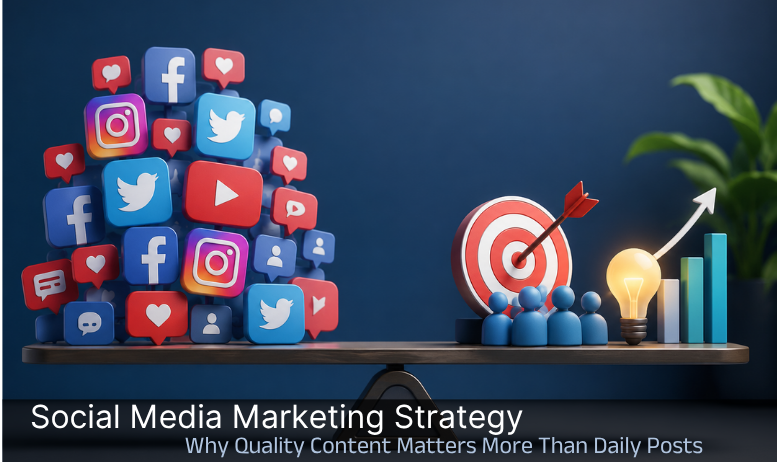
Social Media Marketing Strategy: The Hard Truth About Daily Posting vs Quality Content
Posting every day on social media does not automatically grow your business. A successful Social Media Marketing Strategy focuses on audience understanding, valuable content, meaningful engagement, and measurable goals. Quality content that solves problems builds trust, attracts the right audience, and creates better business outcomes than random daily posts.
Introduction
Posting daily but getting no leads? That’s a common business problem.
A strong Social Media Marketing Strategy is not about filling your calendar with posts. It is about creating content that connects with people, starts conversations, and supports your business goals. Many companies confuse activity with progress.
At TechEnvision, we have spent 15+ years helping businesses improve their online presence with digital marketing and IT solutions. After working with 1000+ happy clients, we’ve seen one pattern repeatedly: businesses don’t fail because they post less. They fail because they post without a clear strategy.
This article explains why quality beats quantity, how businesses can build better social media content strategies, and what actually drives growth.
What Is a Social Media Marketing Strategy?
A Social Media Marketing Strategy is a planned approach to creating, publishing, and managing content on social platforms to achieve business goals such as brand awareness, lead generation, customer engagement, and sales.
It combines audience research, content planning, platform selection, analytics tracking, and continuous improvement. A good strategy focuses on the right message reaching the right audience at the right time.
Does Posting Daily on Social Media Help Business Growth?
The short answer: sometimes, but not by itself.
Daily posting can increase visibility, but visibility alone does not create customers. Social platforms reward content that generates meaningful actions such as comments, shares, saves, and discussions.
Think of social media like a shop window. Changing the display every day helps only if people actually stop and find something valuable. A crowded window with random items does not build trust.
Here’s why posting frequency alone fails:
- Algorithms focus on engagement quality: Platforms consider user interactions, not only posting volume.
- Low-value content damages authority: Repetitive posts can make a brand look less credible.
- Content creation without purpose wastes resources: Your team spends hours producing content that does not move customers toward action.
Truth is, one useful post can outperform ten average ones.
Quality Content Marketing vs Quantity: What Works Better?
The best social media content strategy in 2026 is built around usefulness, not noise.
Businesses should create content that answers customer questions, explains solutions, and demonstrates expertise.
Quality content usually includes:
- Industry insights based on real experience
- Customer problems and practical solutions
- Case studies and success stories
- Educational videos and guides
- Original opinions instead of copied trends
According to Google’s content guidance, helpful content should be created primarily for people, not just search engines. The same principle applies to social media: audiences remember useful brands.
Quality vs Quantity Social Media Approach
A quantity-focused posting approach mainly aims to stay active on social media. Businesses following this method often publish frequent updates without focusing deeply on audience needs or content value.
The content type is usually generic updates that may not provide unique insights or solve customer problems. As a result, the audience response is often limited, with fewer meaningful interactions, shares, or discussions.
This approach may create short-term visibility, but it often struggles to build strong brand recall or long-term customer trust.
On the other hand, a quality-focused social media strategy focuses on building trust and authority. Instead of posting just to maintain consistency, businesses create educational and problem-solving content that helps their audience.
High-quality content encourages stronger engagement through saves, shares, comments, and discussions. It also creates better opportunities for lead generation because people start recognizing the brand as a reliable source of information.
The long-term value of a quality-driven approach is a stronger digital presence, better audience relationships, and sustainable business growth.
How to Build a Better Social Media Content Strategy
A successful strategy does not start with “How many posts should we publish?”
It starts with “What does our audience need?”
Follow these steps:
- Understand Your Audience
Identify:
- Who are your customers?
- What problems do they face?
- Which platforms do they use?
- What type of content influences their decisions?
Audience research prevents businesses from creating content that nobody needs.
- Create Content Pillars
Instead of random posting, build categories around your expertise.
For example:
- Educational content
- Behind-the-scenes updates
- Customer success stories
- Industry trends
- Product or service explanations
Content pillars create consistency without making your brand repetitive.
- Measure Real Engagement
Likes are only one signal.
Track:
- Saves
- Shares
- Comments
- Click-through rate (CTR)
- Website traffic
- Lead conversions
Social media success should connect with business results, not just vanity metrics.
Why Businesses Struggle With Social Media Growth
We’ve audited many campaigns where the issue wasn’t a lack of effort. The problem was direction.
Common mistakes include:
Posting Generic Content
Many businesses share the same basic tips available everywhere. Thin content rarely builds authority.
A small IT company posting “5 benefits of technology” won’t stand out. Sharing a real client challenge, solution, and outcome creates credibility.
Following Trends Without Strategy
Jumping on every viral format can bring temporary attention but may attract the wrong audience.
Your content should support your brand goals, not chase every trend.
Ignoring the Conversion Journey
Social media is only one part of digital marketing.
A visitor may see your post, visit your website, check your services, and contact you weeks later. If your website, landing pages, SEO, and tracking are weak, the funnel leaks.
Real Business Scenarios: Where Strategy Creates Results
A well-planned approach connects content with measurable growth.
Here are examples from common business situations:
Local Business Improving Online Visibility
A local company can combine social media content with local SEO to attract nearby customers. Educational posts, customer reviews, and location-based content strengthen visibility.
E-commerce Store Reducing Wasted Ad Spend
Many online stores spend heavily on PPC campaigns without understanding customer behaviour. Better audience targeting, landing page improvements, and conversion tracking help improve ROAS.
Slow Website Recovering Lost Leads
A slow website works like a leaking bucket. You can bring visitors through social media and SEO, but poor Core Web Vitals and slow pages push customers away.
Startup Building Topical Authority
New companies can build trust by consistently sharing expertise, answering customer questions, and creating content clusters around their niche.
At TechEnvision, we help businesses combine social media marketing, SEO, website development, PPC, and digital solutions to create a stronger online presence: https://www.techenvision.in/
Challenges and Solutions
Challenge 1: Content Gets Views But No Leads
Solution: Connect content with business objectives. Every campaign should have a purpose, whether it is awareness, engagement, or conversion.
Challenge 2: High Advertising Costs With Low Returns
Solution: Improve audience targeting, keyword research, landing pages, and conversion tracking before increasing ad budgets.
Challenge 3: Website and Marketing Channels Work Separately
Solution: Build an integrated digital marketing strategy where SEO, social media, paid campaigns, and website experience support each other.
Conclusion
A successful Social Media Marketing Strategy is not measured by how often you post. It is measured by how effectively your content builds trust, creates engagement, and supports business growth.
Daily posting can help, but only when every piece of content has a clear purpose. Businesses that focus on quality content marketing, audience understanding, and consistent improvement create stronger digital results.
At TechEnvision, we help businesses build practical digital strategies that generate traffic, leads, and sales through social media, SEO, websites, and technology solutions. The goal is simple: create marketing that works.
FAQs
Question: Does posting daily on social media help business growth?
Answer: Daily posting can improve visibility, but it does not guarantee business growth. Growth depends on content quality, audience relevance, engagement, and conversion strategy. A few valuable posts that solve customer problems can create better results than daily content without direction.
Question: What is the best social media strategy for small businesses in 2026?
Answer: The best strategy combines educational content, customer-focused messaging, consistent branding, engagement, and performance tracking. Small businesses should focus on building trust and authority instead of competing only on posting frequency.
Question: How does quality content improve social media engagement?
Answer: Quality content improves engagement by giving audiences a reason to interact. Useful posts encourage saves, shares, comments, and discussions. These signals help platforms understand that the content provides value to users.
Question: How often should a business post on social media?
Answer: There is no universal posting frequency. Businesses should choose a schedule they can maintain while protecting content quality. A consistent strategy with valuable content usually performs better than frequent low-quality posts.